A criminal defense attorney in Albuquerque reflects on what happens in the two blocks between his office and the courthouse — and why walking to court with his clients is one of the most important things he does.
My office is on Lomas Boulevard, a few blocks from the Second Judicial District Court, the Metropolitan Court, and the Federal District of New Mexico Courthouse. When I was looking for a space, proximity to the courts mattered to me — and not only for the obvious reason of convenience, though that is real. It mattered because of what happens in those blocks between my front door and the courthouse steps.
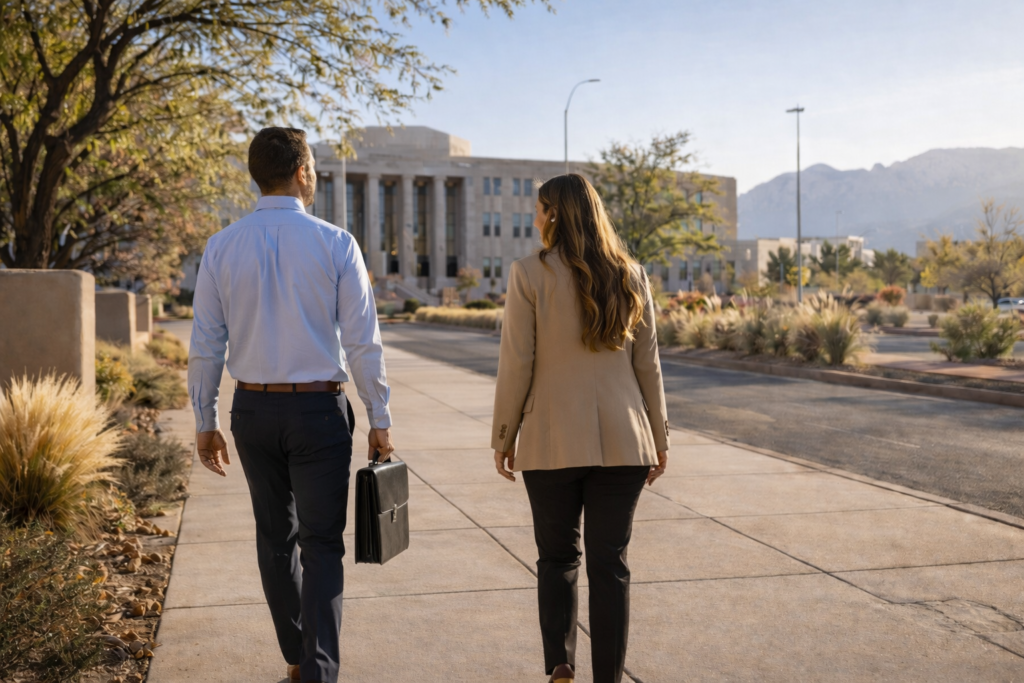
My clients park at my office. They come in before a hearing, we sit together, we talk through what is going to happen. And then we walk. Side by side, down Lomas, toward the courthouse. Two or three blocks. It does not sound like much. But I have come to believe it is one of the most important parts of what I do.
What gets stripped away before we ever reach the courtroom
It is easy to forget, when you have walked into a courthouse hundreds of times, what that experience feels like the first time. The parking, the security line, the unfamiliar corridors, the search for the right courtroom — each of these is a small tax on a person who is already carrying a great deal. Fear, uncertainty, the weight of what is at stake. For many of my clients, a court hearing is not just uncommon. It is an experience they have never had before, and one they are facing because something has gone wrong in their lives.
When a client parks at my office and walks with me, all of that navigational stress simply disappears. They do not have to figure out where to park, or how to get through security, or which floor to go to. I handle it. What they can do instead is be present — and presence, in my experience, is what makes the difference between a client who is reactive and a client who is in control of themselves.
I think about this in terms of what my philosophy training taught me about agency. A person exercising genuine agency — making real decisions based on their own values and understanding — needs a certain amount of cognitive and emotional space. Flood that space with logistical anxiety and what you get is not decision-making. What you get is survival response. My job is to help my clients think clearly and act in their own best interest. Clearing the path so they can actually walk it is part of that.
What opens up when you walk side by side
There is something else that happens on those walks, and it took me a while to fully appreciate it.
In my office, I sit across from my clients. There is a desk between us. That setup is useful — it is a good environment for gathering facts, reviewing documents, building a strategy. But it is also a structured, formal context, and for many of the people I represent, that formality carries weight that goes beyond the current situation. A desk, a suit, an office — these are not neutral symbols. For people who have grown up navigating systems that were not built for them, or that have actively worked against them and their community, a person of authority seated across a desk can register as a threat before a single word is exchanged. That is not paranoia. That is pattern recognition, earned through real personal and collective experience. A public defender, a social worker, a teacher, a cop — from a certain distance, we can all look the same. The person across the desk has power, and power has not always been safe.
I cannot undo that history in a consultation. But I can change the context. Walking side by side, we are no longer across from each other — we are moving in the same direction, toward the same goal. That shift is physical before it is psychological, and the psychological follows. The conversation that opens up on those blocks is different in quality from the one that happens in a chair under direct eye contact. It is more spontaneous, less performed. People say things while walking that they would not say while being looked at directly across a desk.
This matters because what I need from my clients is not just the facts of their case. I need to understand them — how they think, their struggles, what they value, and what they are capable of. My legal knowledge and trial experience are only as useful as my ability to deploy them in service of the actual person in front of me. Walking together is one of the ways I access that.
A wise attorney will not break a door down with a hammer when he can open it with the key in his hand.
That is how I think about the walk. The key, not the hammer.
John
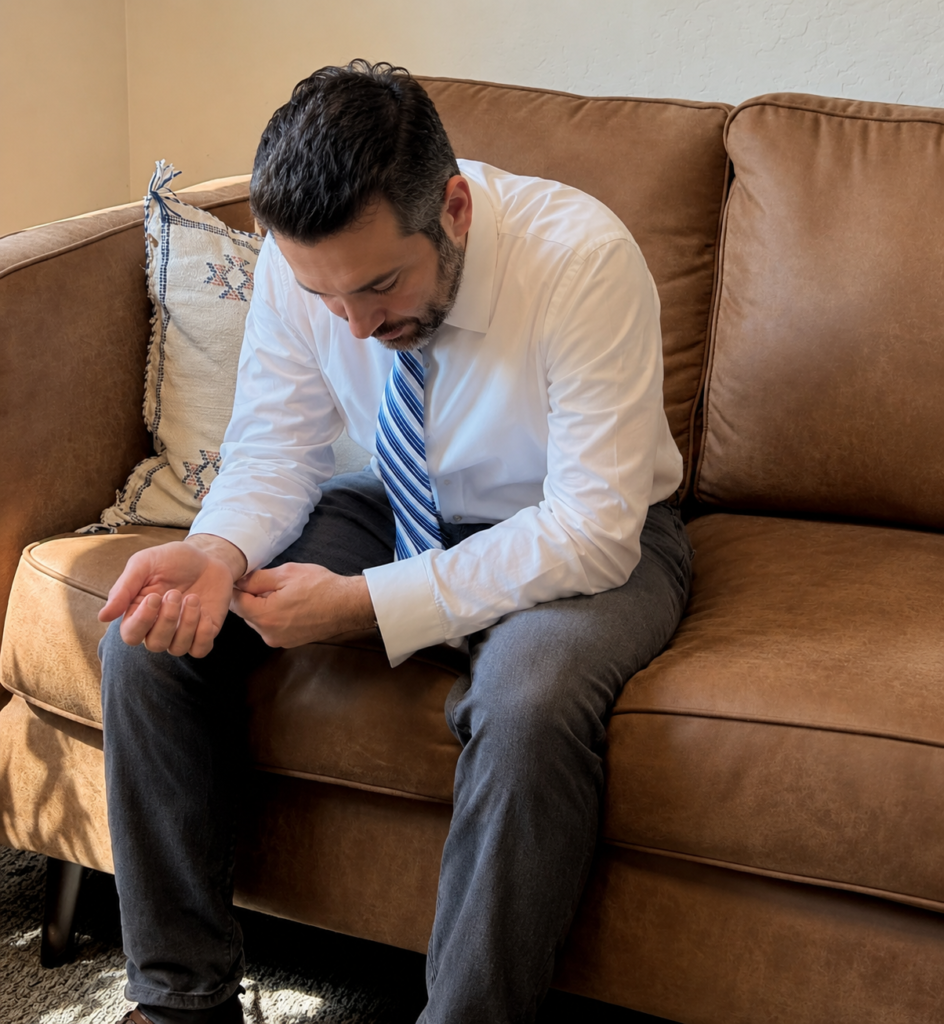
I want to tell you about a client I will call John*. John had never been in trouble with the law. He was a person with a good career, a family he loved, and real plans for his future. But he had struggled with his temper for a long time, and when things finally broke, they broke badly. What he was facing was serious. The charge was serious. The potential consequences for his life were serious.
John was not a hardened person navigating a familiar system. He was a frightened person navigating a foreign one. When he arrived at my office before our first court appearance, I could see it immediately. He was carrying all of it — the fear, the shame, the uncertainty about what was going to happen and whether any of it was going to be okay.
We had a plan. I believed in the plan. But belief in a plan is not the same as feeling steady enough to walk into a courtroom and execute it.
So we walked. And on the way, we talked. Not about the legal mechanics — we had already covered that. We talked about what was going to happen when we got inside, what I was going to say, how I thought the judge was likely to respond, why I thought if we stayed the course we were going to get where we needed to go. By the time we arrived at the courthouse, something had shifted. He was still nervous. But he was no longer alone with it. And that is a different thing entirely.
Over the course of that case, we walked to court together a number of times. Each walk built something. Not just reassurance — understanding. John came to understand his own case more deeply, and I came to understand him. When the time came to make important decisions, he made them from a place of clarity rather than fear. He knew what he was choosing and why. He also trusted my counsel. That is what I want for every client. And that case ended well.
Calm is not a luxury — it is a legal asset
I want to be direct about something, because I think it gets lost in how people typically think about criminal defense. The psychological state of my client during their case is not a soft concern, separate from the hard work of legal strategy. It is part of the legal strategy.
A client who is calm can make good decisions. A client who is overwhelmed makes decisions based on fear and intimidation — and those decisions rarely serve their actual interests. When I work to reduce my client’s stress, I am not just being kind. I am doing my job. The outcomes that my clients deserve come from the best version of them, not the most frightened version.
The walk is one part of that. The in-house support that Janeth Nuñez del Prado, our licensed clinical social worker, provides is another. The way I run consultations is another. Everything is designed around the same principle: a person who can think clearly is a person who can fight for themselves. My job is to make sure they have every advantage — including the advantage of not being consumed by anxiety when it matters most.
A few blocks on Lomas
I chose my office location deliberately. The walk is not an accident. It is, in a small but real way, a philosophy.
Criminal defense is often described as a battle — and it is. I have tried 86 cases. I know what it costs to go to war on behalf of another person, and I do not take that lightly. But the fight does not begin at counsel’s table. It begins in the parking lot, or the office, or the conversation on the walk over. It begins the moment a client feels safe with you and knows that they are not alone in what they are facing.
If you or someone you love is facing criminal charges, I want you to know that this is how I work. Not just as a strategist, but as an advocate in the fullest sense of the word. Call me at 505-226-2249 for a free consultation. We will figure out where we are going — and then we will walk there together.
* “John” is a composite client, and identifying details have been changed to protect confidentiality.