Charged With a Felony in Albuquerque, New Mexico? What Happens Next?
Understanding the felony criminal court process in Bernalillo County, from arrest to District Court
By Max Pines Law | Albuquerque, New Mexico
Being charged with a felony can be an overwhelming experience. Many people have never been involved in the criminal justice system before and have little understanding of what will happen, how long the process will take, whether they will be held in jail, or when they will have an opportunity to defend themselves. Clients and their families always want to know: if they have Felony Charges in Albuquerque: What Happens Next?
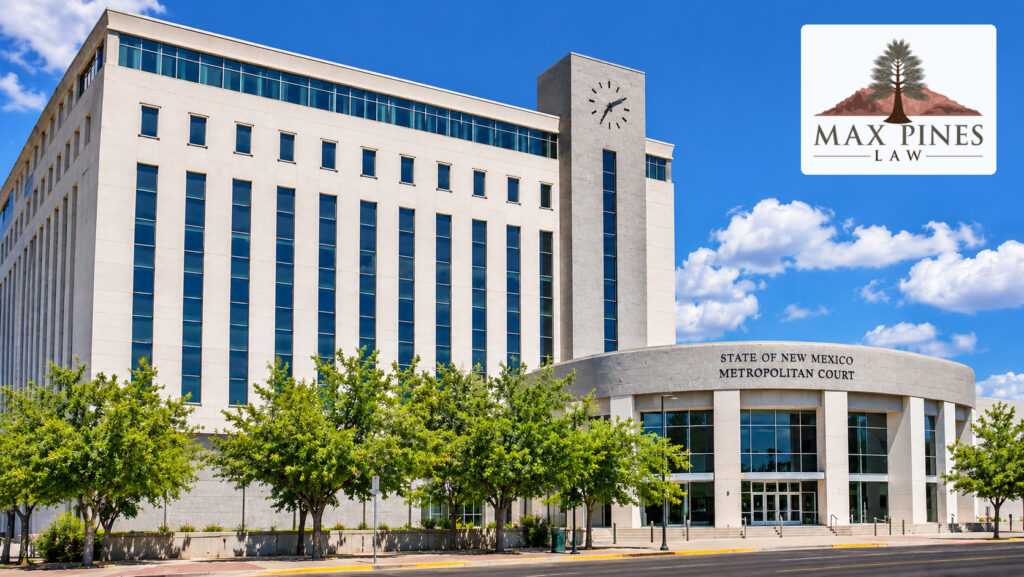
In Albuquerque and throughout Bernalillo County, felony cases initiated by criminal complaint generally follow a predictable procedural path, beginning in the Bernalillo County Metropolitan Court and eventually moving to the Second Judicial District Court.
This article explains how that process typically works in Albuquerque when the prosecution is not seeking pretrial detention.
1. The Arrest or Issuance of an Arrest Warrant
A felony criminal case often begins in one of two ways. A person is either arrested at the scene of an alleged crime, or law enforcement conducts an investigation and subsequently obtains a warrant for that person’s arrest.
The Albuquerque Police Department (APD) frequently obtains arrest warrants following investigations when an immediate arrest has not been made.
Sometimes a person learns that there is a warrant for their arrest before the police actually arrest them. This is an excellent opportunity to get a criminal defense attorney involved.
2. Can an Attorney Help With a Felony Arrest Warrant?
An attorney can file a motion asking the Metropolitan Court to cancel or recall an outstanding felony arrest warrant.
In our experience, Metropolitan Court judges do not simply cancel these warrants in advance. Instead, the court will often schedule a felony first appearance, allowing the defendant to appear voluntarily with their attorney. This takes time and is why you should get an attorney and act on this promptly… the longer you have an active warrant, the more likely you are to be arrested and taken to jail.
At that hearing, the judge may authorize what is commonly referred to as a book and release. This allows the defendant to complete the required booking procedures and be released without an extended stay in jail, provided there are no other holds or circumstances preventing release.
Although an outstanding warrant remains active until it is addressed by the court, this process can provide a more orderly and predictable way of dealing with a felony charge.
Rather than waiting anxiously for the police to make an arrest, a person can begin addressing the situation proactively with the assistance of an attorney.
3. The Felony First Appearance (FFA)
The first court hearing in a felony case is generally called a Felony First Appearance, or FFA.
For defendants who are arrested and held locally, this hearing generally occurs within 72 hours.
At this hearing, the judge advises the defendant of the charges and addresses the conditions under which the defendant will be released while the criminal case is pending.
When the District Attorney’s Office is not seeking pretrial detention, the defendant will ordinarily be released subject to appropriate conditions, assuming there are no other warrants, probation holds, or legal circumstances preventing release.
Depending on the nature of the charges and the defendant’s circumstances, conditions of release may include:
- Reporting to pretrial services;
- Having no contact with an alleged victim;
- Restrictions on possessing firearms;
- Restrictions on travel;
- Drug or alcohol testing;
- GPS monitoring; or
- Requirements to attend all scheduled court hearings.
It is important to understand that the felony first appearance is not a trial. The judge is not deciding whether the defendant is guilty or innocent.
Once released, the defendant must comply with the conditions of release throughout the pendency of the case unless those conditions are modified by the court.
4. The Mandatory Felony Status Conference — Approximately 30 Days Later
The next hearing is typically a mandatory felony status conference, scheduled approximately one month after the felony first appearance.
In Bernalillo County, defendants are generally required to attend this hearing personally and in person, even when they are represented by an attorney. Failing to appear can result in another warrant being issued for their arrest.
By this stage of the case, the defense attorney should have received at least some of the evidence from the prosecution. This evidence, commonly referred to as discovery, may include police reports, witness statements, body camera recordings, photographs, and other investigative materials.
The prosecutor may also have extended a plea offer.
The status conference provides an opportunity for the defense attorney to:
- Review the available evidence;
- Identify weaknesses in the prosecution’s case;
- Discuss potential resolutions with the prosecutor;
- Evaluate any plea offer with the client;
- Seek modifications to conditions of release when appropriate; and
- Prepare for the preliminary hearing.
Some cases can be resolved favorably at this early stage. Others require substantially more investigation and litigation.
If the case is not resolved, it will ordinarily proceed to a preliminary hearing.
5. The Preliminary Hearing — Approximately 60 Days Into the Case
For a defendant who is out of custody, the preliminary hearing generally takes place within 60 days of the felony first appearance, subject to certain exceptions and extensions.
In practice, this often means approximately another month after the mandatory status conference. The preliminary hearing must be held within 60 days of the Felony First Appearance.
At the preliminary hearing, the prosecution must establish probable cause to believe that a felony offense occurred and that the defendant committed it.
The prosecutor may call police officers, alleged victims, or other witnesses to testify. The defense attorney has an opportunity to cross-examine witnesses and challenge the sufficiency of the prosecution’s evidence.
Probable Cause Is a Relatively Low Standard of Proof
One of the most important things for defendants to understand is that the prosecution’s burden at a preliminary hearing is considerably lower than its burden at trial.
At a criminal trial, the prosecution must establish guilt beyond a reasonable doubt. At a preliminary hearing, the prosecution only needs to establish probable cause.
There may be significant questions about a witness’s credibility, inconsistencies in statements, conflicting versions of events, or uncertainty about exactly what happened. Nevertheless, the judge may find sufficient probable cause for the case to proceed.
In many felony cases, the preliminary hearing is not where the ultimate merits of the case will be decided.
That does not mean the preliminary hearing is unimportant. A skilled criminal defense attorney can use this hearing to obtain sworn testimony, expose weaknesses in the prosecution’s theory, preserve inconsistencies for later use, and potentially secure the dismissal of charges that are not adequately supported by evidence.
If the judge does not find probable cause, the affected felony charges are dismissed without prejudice, meaning the prosecution may be able to pursue them again.
If the judge finds probable cause, the case will be bound over to District Court.
6. What Does It Mean When a Felony Case Is Bound Over to District Court?
Being bound over to District Court does not mean that the defendant has been found guilty. Nor does it necessarily mean that the prosecution has a strong case.
It simply means that the prosecution has satisfied the preliminary legal threshold necessary for the felony case to proceed.
The case then moves from the Bernalillo County Metropolitan Court to the Second Judicial District Court, where it will proceed as a felony prosecution under a different set of procedural rules.
This is where much of the substantive litigation of a felony criminal case takes place.
The District Court phase may involve:
- Arraignment and entry of a not-guilty plea;
- More extensive discovery;
- Independent defense investigation;
- Pretrial interviews of witnesses;
- Consultation with expert witnesses;
- Motions to suppress illegally obtained evidence;
- Challenges to the admissibility of evidence;
- Motions to dismiss charges;
- Plea negotiations; and
- Preparation for a jury trial.
The conditions of release previously imposed by Metropolitan Court generally remain in effect unless modified by the District Court.
Depending on the complexity of the case, the District Court phase can last several months or considerably longer.
The Typical Timeline of a Felony Case in Albuquerque
For a felony case initiated in Metropolitan Court in which the defendant is released from custody and the case is not resolved early, a typical timeline looks like this:
| Approximate timing | Stage of the case |
|---|---|
| Beginning | Arrest or issuance of an arrest warrant |
| Initial days | Felony first appearance and conditions of release |
| 30 days | Mandatory felony status conference |
| 60 days | Preliminary hearing |
| Following bind-over | District Court arraignment and scheduling |
| Following months | Investigation, discovery, motions, negotiations and possible trial |
Not every felony case follows this exact path. The prosecution may also obtain a grand jury indictment, which allows a felony case to proceed in District Court without a preliminary hearing. Dismissals, negotiated resolutions, extensions and other circumstances may also affect the timeline.
Why You Should Hire a Criminal Defense Attorney Early
One of the biggest mistakes people make when facing felony criminal charges is waiting too long to involve a criminal defense attorney.
The Metropolitan Court phase of a felony case presents important opportunities. An attorney may be able to help address an outstanding arrest warrant, advocate for less restrictive conditions of release, preserve evidence, identify favorable witnesses, negotiate with the prosecution, and establish a foundation for the defense of the case in District Court.
Getting a lawyer involved early can also reduce some of the anxiety that comes with not knowing what will happen next.
If you believe you are under investigation for a felony, you do not need to wait until you are arrested to consult with a lawyer. You should seek legal advice before speaking with law enforcement about the allegations.
At Max Pines Law, we represent individuals facing felony criminal charges in Albuquerque, Bernalillo County, and throughout New Mexico. We work closely with our clients to help them understand the criminal court process, make informed decisions, and develop a defense strategy tailored to their individual circumstances.
A felony charge is serious, but it is the beginning of a legal process — not a determination of guilt.
If you or a loved one is facing felony criminal charges in New Mexico, contact Max Pines Law to discuss your case.
This article provides general information about New Mexico criminal procedure and is not a substitute for legal advice regarding an individual case.