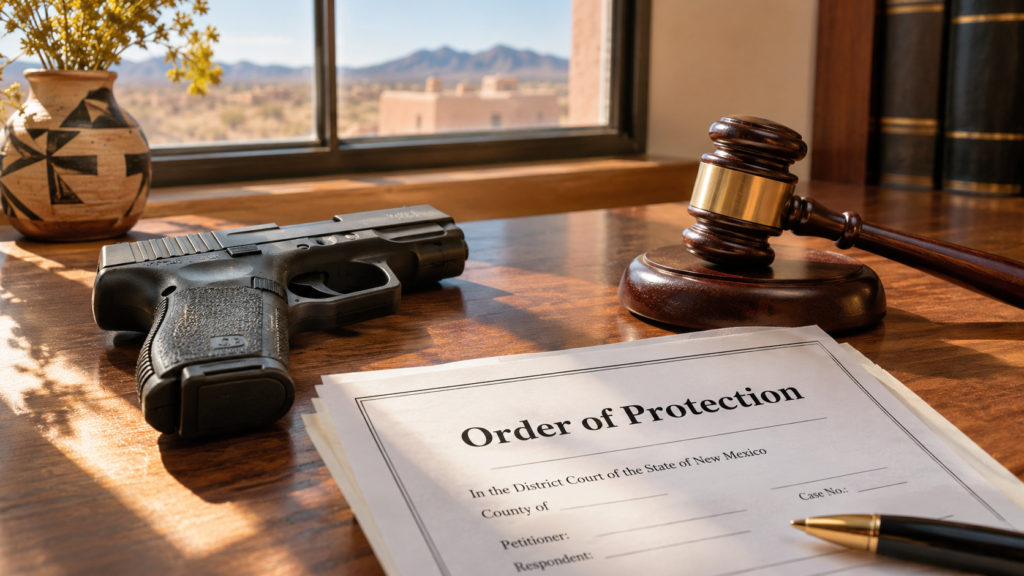
Domestic Violence and Firearm Rights in New Mexico: Understanding State and Federal Law
If there is strife within your family, the consequences can be very severe with respect your second amendment rights. Can you own a gun after a misdemeanor domestic violence conviction in New Mexico? What if you are subject to a civil order of protection but have never been convicted of a crime? Will you get your firearm rights back after completing probation?
The answers to these questions can be surprisingly complicated because two separate bodies of law govern firearm possession in New Mexico: state law and federal law.
Even when a domestic violence case results in no jail time and even if the conduct was not especially violent or terrible, the consequences for a person’s constitutional right to possess firearms can be significant and potentially lifelong.
1. Domestic Violence (DV) Convictions Under New Mexico Law
First what happens if you receive a conviction for DV under state law? In 2019, New Mexico substantially expanded its restrictions on firearm possession by individuals convicted of certain criminal offenses.
Under NMSA 1978, Section 30-7-16(A)(3), a person is prohibited from receiving, transporting or possessing a firearm or destructive device after being convicted of any of the following offenses:
- Battery against a household member (§ 30-3-15);
- Criminal damage to property of a household member (§ 30-3-18);
- A first offense of stalking (§ 30-3A-3); or
- An offense falling within the statute’s reference to federal law under 18 U.S.C. § 921.
Importantly, these restrictions are not limited to felony convictions; a felony conviction precludes you from owning a firearm under State law for 10 years. A misdemeanor conviction can result in an indefinite prohibition on firearm possession.
Unlike certain restrictions applicable to felony convictions under New Mexico law, the statute does not establish an automatic expiration date for its expressly listed domestic violence and stalking convictions.
Completing probation, paying fines, attending domestic violence counseling and remaining out of trouble do not, by themselves, remove the prohibition.
Violating this restriction can result in a new misdemeanor criminal charge punishable by up to 364 days in jail and a $1,000 fine.
2. Domestic Violence Convictions Under Federal Law
In 1996, Congress enacted what is commonly known as the Lautenberg Amendment, prohibiting firearm possession by individuals convicted of qualifying misdemeanor crimes of domestic violence. The federal prohibition is found in 18 U.S.C. § 922(g)(9), with the relevant definition provided in 18 U.S.C. § 921(a)(33).
This rule for DV convictions applies very broadly because this is a federal law.
Generally, a qualifying misdemeanor must include as an element the use or attempted use of physical force or a threat involving a deadly weapon. The offense must also have been committed against someone with whom the defendant had a qualifying domestic relationship.
These relationships include:
- Current or former spouses;
- Parents or guardians of the victim;
- Individuals who share a child;
- Individuals who live or previously lived together in certain familial or intimate relationships;
- Individuals similarly situated to a spouse, parent or guardian; and
- Certain current or recent former dating partners.
The federal definition of physical force is broader than many people might expect. Even offensive physical contact that does not result in significant injury can qualify.
Additionally, the criminal offense does not necessarily need to have the words “domestic violence” in its title. In United States v. Hayes, 555 U.S. 415 (2009), the United States Supreme Court held that a conviction under a general battery statute may qualify if the required domestic relationship existed.
This means that negotiating a domestic violence charge down to ordinary battery does not necessarily protect a person’s firearm rights.
3. Is the Federal Firearm Prohibition Permanent?
For most qualifying domestic violence misdemeanor convictions involving spouses, former spouses, co-parents and other traditionally covered domestic relationships, the federal prohibition has no automatic expiration date.
However, Congress created an important exception in 2022 through the Bipartisan Safer Communities Act.
The Five-Year Rule for Certain Dating Relationships
The 2022 legislation expanded federal firearm restrictions to include qualifying domestic violence convictions involving certain dating partners, even when the individuals never married, lived together or had children together.
For qualifying convictions involving dating relationships covered by this expansion, federal firearm eligibility may be restored after five years, provided that:
- The individual has only one qualifying dating-related domestic violence conviction;
- Five years have passed since the conviction or completion of incarceration or supervision, whichever occurred later;
- The individual has not subsequently been convicted of certain violent or otherwise disqualifying offenses; and
- No other federal firearm prohibition applies.
The expansion to dating relationships generally applies to convictions entered on or after June 25, 2022.
Here is where New Mexico law becomes especially important: Even if a person becomes eligible to possess firearms under federal law after five years, that person may remain prohibited under New Mexico law because of a conviction for battery against a household member or another expressly listed offense.
The federal five-year rule does not override an independent state prohibition.
4. Orders of Protection and Firearm Possession
A person does not need to be convicted of a crime to lose the right to possess firearms.
An order of protection issued in a civil domestic violence proceeding can also restrict firearm possession.
Under New Mexico’s Family Violence Protection Act, Section 40-13-5, a court must impose firearm restrictions when the applicable statutory requirements are met, including a determination that the restrained party presents a credible threat to the physical safety of a household member following notice and an opportunity to be heard, or by stipulation.
When firearm relinquishment is required, Section 40-13-13 generally requires the restrained party to surrender firearms within 48 hours of service of the order to an authorized law enforcement officer, agency or federally licensed firearms dealer.
The law also requires documentation of compliance with the court.
New Mexico’s criminal firearm possession statute, Section 30-7-16(A)(2), separately prohibits firearm possession by persons subject to orders issued under Section 40-13-5 or registered foreign protection orders under Section 40-13A-5.
Consequently, it is important to understand both the specific language of the order and the independent restrictions imposed by state law.
Unlike a conviction-based prohibition, a restriction based solely on an order of protection generally ends when the order expires or is terminated, assuming no other legal prohibition exists.
Under Federal Law also, most order of protection situations arising out of New Mexico will qualify for federal prohibition too.
5. Comparing New Mexico and Federal Firearm Restrictions
| Issue | New Mexico Law | Federal Law |
|---|---|---|
| Domestic violence misdemeanor | Prohibited for specified convictions | Prohibited for qualifying convictions |
| Criminal damage to household member’s property | Expressly prohibited | Does not automatically qualify as domestic violence |
| Misdemeanor stalking | Expressly prohibited | Does not automatically qualify as domestic violence |
| Duration of conviction-based prohibition | Generally indefinite for expressly listed offenses | Generally indefinite, with certain exceptions |
| Five-year dating relationship exception | No equivalent express exception for listed New Mexico offenses | Available for certain qualifying convictions |
| Civil orders of protection | Prohibited under specified state statutes | Prohibited when federal statutory requirements are met |
| Ammunition alone | Not expressly prohibited by § 30-7-16 | Expressly prohibited |
| Maximum penalty for prohibited possession discussed here | 364 days in jail and $1,000 fine for the misdemeanor | 15 years in federal prison and potentially substantial fines |
The difference in potential punishment is particularly significant. Conduct that constitutes a misdemeanor under New Mexico law can also constitute a serious federal felony.
6. Why Firearm Rights Should Be Discussed Before Accepting a Plea Agreement
When defending a domestic violence case, an attorney should consider more than the immediate consequences of a conviction.
A plea agreement that involves no jail time, a relatively short period of probation and completion of counseling may initially appear attractive. But for someone who hunts, owns firearms, works in law enforcement, serves in the military or relies on firearms for employment, the long-term consequences may be far more significant than the sentence itself.
These issues should also be considered before agreeing to the entry of a civil order of protection, even when there is no accompanying criminal case.
Once a conviction has been entered, preserving or recovering firearm rights may become considerably more complicated.
Domestic Violence Defense at Max Pines Law
At Max Pines Law, we believe that effective criminal defense requires understanding the long-term consequences of a criminal case, not simply negotiating the immediate sentence.
We represent individuals facing domestic violence charges and other criminal allegations in Albuquerque and throughout surrounding New Mexico communities.
If you are facing a domestic violence charge, have been served with an order of protection or are concerned about whether a prior conviction affects your firearm rights, we encourage you to seek legal advice before making decisions that could have lasting consequences.
Understanding your rights before resolving a case is often much easier than trying to recover those rights afterward.
Max Pines Law | Albuquerque, New Mexico
This article provides general legal information and is not a substitute for individualized legal advice.